Build a usable forecast
Define the target and information rule, derive a model, and compare it with a benchmark on chronological targets.
A graduate course · First edition
Learn to defend a forecast through its economic purpose, mathematical argument, information set, and behavior on later outcomes.
By Ian Helfrich, PhD
Fifteen lectures. Complete derivations and worked practice. Executable examples in R, Julia, and Python; choose one language for study.
A model's derivation, implementation, audit, and revision belong to the same learning sequence.
Each lecture begins with an economic decision, develops the relevant mathematics, and tests it using matched code. Deliberate failure cases expose the assumptions. A repair must address the identified failure and survive a later comparison.
The applications connect financial risk with economic measurement, geographic exposure, and regional networks. The core remains time-series econometrics: stationary processes, integrated levels, dynamic regression, latent states, multivariate systems, cointegration, and conditional volatility.
Each lecture has a chapter, an assignment, a laboratory, and a one-page summary.
Read the chapter and work its derivations. Attempt the three tasks of the matching assignment on the practice page before opening the worked answers. Run the chapter's entry point from the laboratory bundle in one language, predict each reported quantity before running it, and carry out the chapter's break-and-repair exercise. Where an interactive experiment exists, use it to test a prediction. The lecture summary then checks that you can state the central relation, the failure, and the repair with the chapter closed.
The course assumes probability through conditional expectation and Gaussian conditioning, linear algebra through eigenvalues and orthogonal matrices, and least-squares regression in matrix form. Each chapter lists its own prerequisites.
The complete course
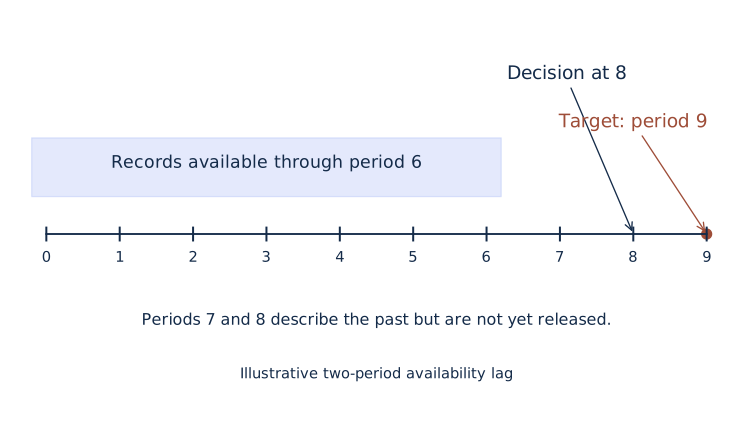
What could the decision maker actually have known?
information sets · vintages · target definitions · geographic aggregation · naive forecastsHow does a shock persist, and what changes when observations are aggregated?
difference equations · AR1 · stationarity · moments · multi-step forecasts · temporal aggregationCan the observed history reveal the shocks that generated it?
ARMA · lag polynomials · stationarity · invertibility · ACF · PACF · information criteria · conditional estimationHas the model improved a decision on targets it had not seen?
rolling origins · horizons · loss · forecast intervals · parameter uncertainty · Diebold–Mariano · nested models · residual diagnosticsDoes a cleaner-looking series preserve the information available at the decision date?
latent quantities · measurement error · filtering · centered averages · composition · revisionsWill a shock decay, or permanently change the path?
deterministic trends · stochastic trends · integration · differencing · DF · ADF · KPSS · spurious regression · Monte Carlo errorIs the model using a feasible predictor or explaining the future after it happened?
dynamic regression · ARMA errors · Fourier seasonality · weather response · feasible GLS · scenariosHow much should a new observation change our estimate of the economic state?
state equations · observation equations · Kalman gain · filtering · smoothing · missing dataDoes another region's history add information about this region's future?
VAR · matrix recursion · eigenvalue stability · cross-lags · Granger causality · networks · forecast covarianceWhich assumptions turn an unexplained movement into an economic shock?
structural shocks · Cholesky ordering · impulse responses · local projections · rotational ambiguity · network identificationCan two wandering prices have a stable spread?
cointegration · common trends · equilibrium errors · ECM · residual testing · weak exogeneityCan tomorrow's risk be predictable when tomorrow's return is not?
conditional heteroskedasticity · ARCH · GARCH · likelihood · variance forecasts · risk quantiles · scalingWhat evidence should make a forecaster stop using a model?
breaks · rolling windows · expanding windows · loss dependence · measurement drift · retirementWould the revised procedure still look good on an outcome it has not helped select?
validation · revision freezes · continuation tests · provenance · replication · decision memosWhich parts of the argument remain valid when the setting changes?
transfer · invariance · model choice · forecast risk · identification · individual defenseDefine the target and information rule, derive a model, and compare it with a benchmark on chronological targets.
Replicate a result, construct a counterexample, and repair a specific issue in timing, measurement, dynamics, or interpretation.
Use later evidence to retain, revise, or retire the procedure, then evaluate the declared rule on continuation outcomes.
Every lecture and project has independent source in three languages. Fixed fixtures and provider extracts make the examples runnable without API credentials.
The verification suite checks analytic quantities, future-information mutations, units, variance restrictions, numerical agreement, and matched forecast records. Its report includes failed-case tests and the outcome in which a seasonal benchmark narrowly beats the revised model on preliminary 2025 data.
Download source, data, and verification results →