4 Multipliers
4.1 The general multiplier
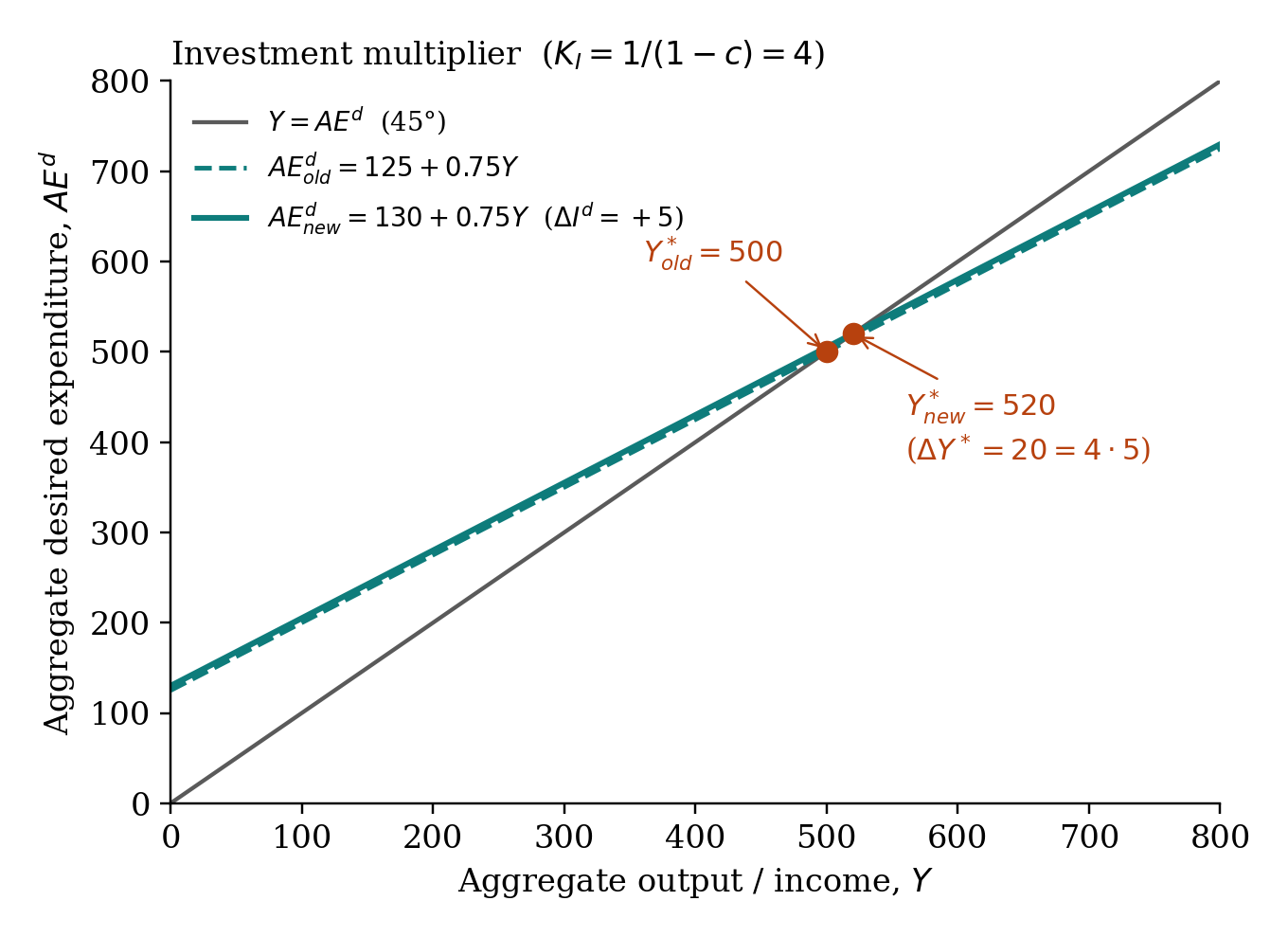
For any autonomous variable \overline{X}:
K_X \equiv \frac{\Delta Y^*}{\Delta \overline{X}}
In the open governed economy with consumption C = \overline{C_0} + c(Y - \overline{T}), equilibrium is
Y^* = \tfrac{1}{1-c}\,\overline{C_0} - \tfrac{c}{1-c}\,\overline{T} + \tfrac{1}{1-c}\,\overline{I} + \tfrac{1}{1-c}\,\overline{G} + \tfrac{1}{1-c}\,\overline{X} - \tfrac{1}{1-c}\,\overline{M}
Each multiplier is the coefficient on its own term:
| variable | multiplier | sign |
|---|---|---|
| \overline{C_0}, \overline{I}, \overline{G}, \overline{X} | \dfrac{1}{1-c} | + |
| \overline{T} | -\dfrac{c}{1-c} | – |
| \overline{M} | -\dfrac{1}{1-c} | – |
| \overline{G} and \overline{T} together by same \Delta | K_{BB} = K_G + K_T = 1 | + |
At MPC c = 0.75: K_G = 4, K_T = -3, K_{BB} = 1.
Mnemonic. “Spending in, full power. Tax in, lose one round of c. Together, exactly one.”
4.2 Why the multiplier exists — the geometric series
A $1 increase in \overline{G} raises Y by $1 in round one. Households see income rise by $1 and spend c of it. That’s round-two spending. Round three adds c^2; round four c^3. Sum:
\Delta Y = 1 + c + c^2 + c^3 + \cdots = \frac{1}{1-c}
This is why K_G = 1/(1-c).
4.3 Why |K_T| is smaller than K_G
A dollar of G enters AE^d in full on round one. A dollar of tax cut adds only c to round-one spending — households save (1-c) of it. The lost round-one (1-c) is the entire gap:
K_G - |K_T| = \tfrac{1}{1-c} - \tfrac{c}{1-c} = \tfrac{1-c}{1-c} = 1
That gap of exactly 1 is the balanced-budget multiplier. Same arithmetic.
The real-world multiplier is roughly 1.4, not 4. The textbook formula assumes no leakages other than saving. Real-world leakages: income-conditional taxes, imports, monetary offset (Fed raises rates as Y rises), crowding-out of private investment. All shrink the multiplier.
4.4 The multiplier dashboard
A live calculator that shows all multipliers for any MPC is at the Multiplier dashboard. Move the slider, watch the table.