3 The Keynesian cross
3.1 The simplest closed-economy model
Households consume out of income; firms invest a fixed amount that doesn’t depend on Y.
AE^d = C(Y) + I^d \quad\text{where } C(Y) = \overline{C_0} + cY \text{ and } I^d = \overline{I}
Equilibrium output is the level where firms’ production exactly matches what households and firms want to spend:
Y = AE^d
Substitute and solve:
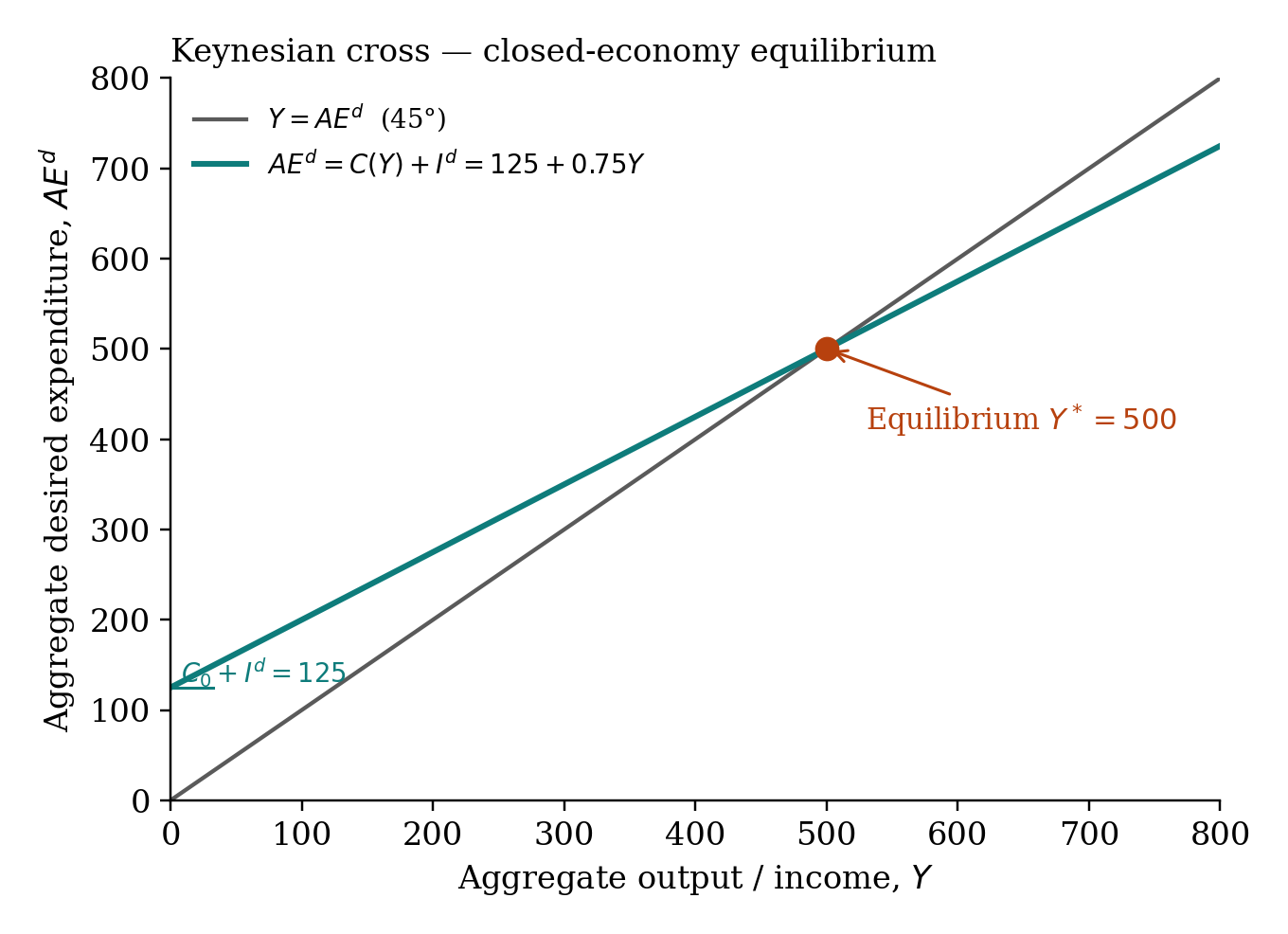
Y = \overline{C_0} + cY + \overline{I} (1 - c) Y = \overline{C_0} + \overline{I} \boxed{\;Y^* = \dfrac{\overline{C_0} + \overline{I}}{1 - c}\;}
3.2 The cross diagram
The 45° line plots Y = AE^d — the equilibrium condition. The AE^d schedule plots desired expenditure as a function of Y. They cross at Y^*.
3.3 Off-equilibrium adjustment
Actual investment includes any unintended buildup or rundown of inventory:
I_{\text{actual}} = I_{\text{planned}} + \Delta\text{unplanned inventory}
If Y > AE^d: production exceeds desired demand. Inventory accumulates (unplanned). Firms cut output. Y falls toward Y^*.
If Y < AE^d: desired demand exceeds production. Inventory runs down. Firms expand. Y rises toward Y^*.
At Y^*: unplanned inventory change is zero.
3.4 The saving = investment alternative
In the closed-economy frugal model, Y \equiv C + S and AE^d = C + I^d. At equilibrium:
C + S = C + I^d \quad\Rightarrow\quad S = I^d
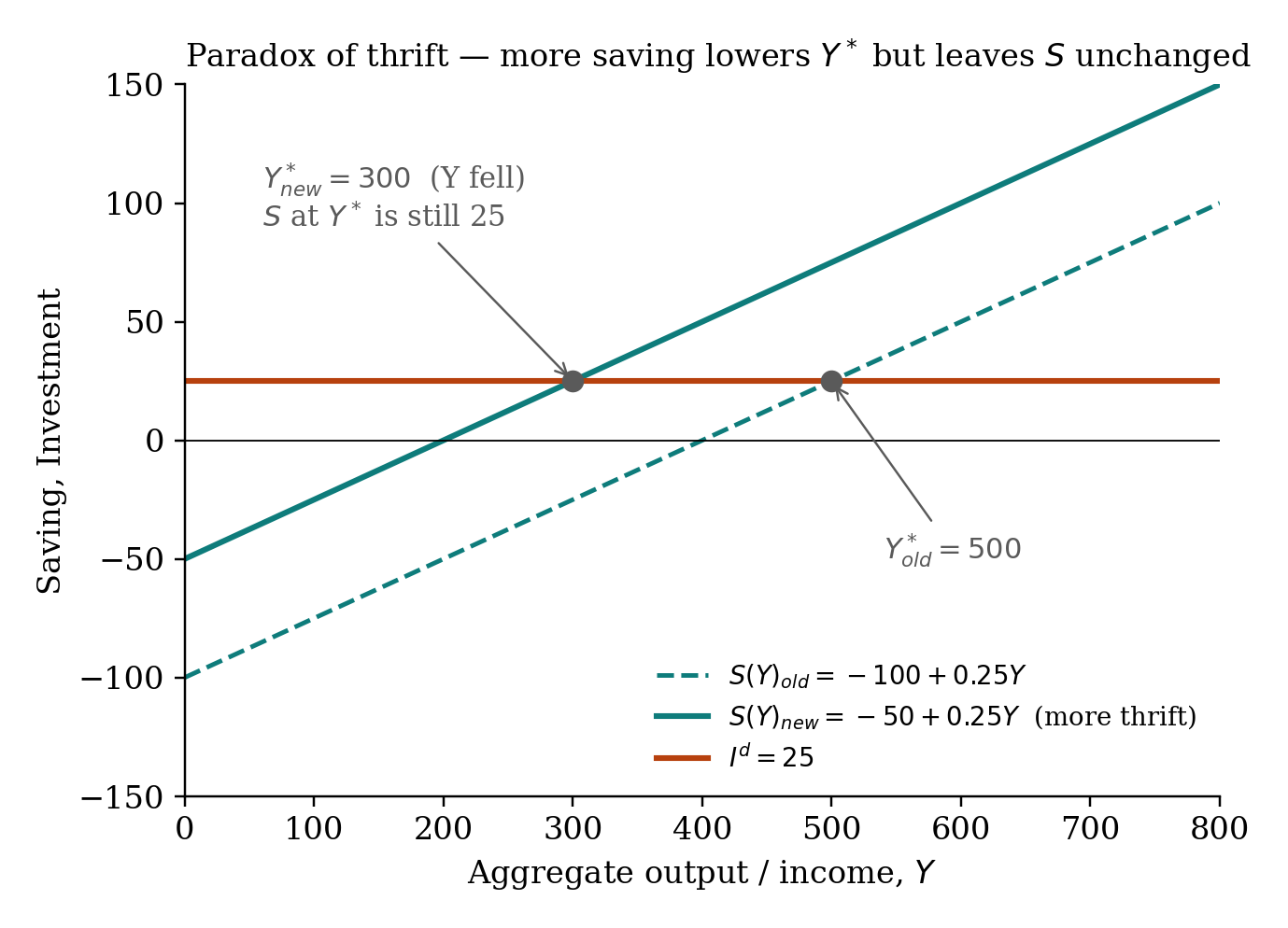
This gives a second way to find Y^*: where the saving function S(Y) = -\overline{C_0} + (1-c)Y crosses the horizontal I^d line.
3.5 Paradox of thrift
If households become more frugal — subsistence consumption \overline{C_0} falls — the saving function shifts up. The new equilibrium has lower Y^*. But S = I^d at equilibrium and I^d didn’t change, so total saving is unchanged. More desire to save, no more actual saving, lower output.
3.6 Try it live
Sliders for MPC, \overline{C_0}, \overline{I} are in the Keynesian Cross tool. Watch Y^* and the multiplier update in real time.